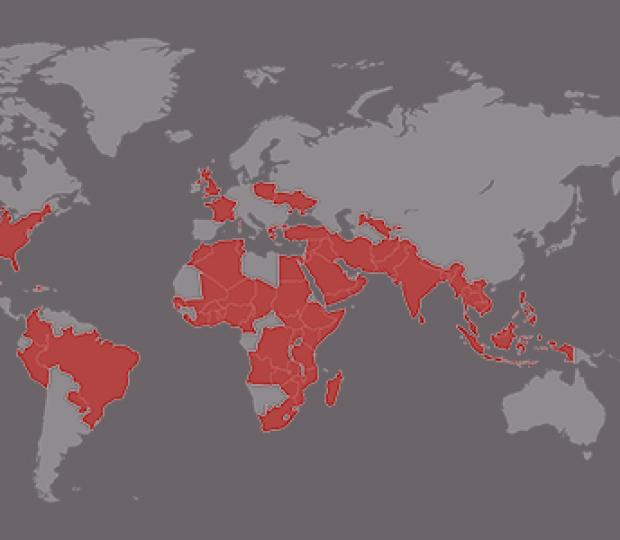
Disclaimer: This map is provided to facilitate the general location of the EAA supported projects. EAA does not have an official position regarding boundaries of or
disputed boundaries between countries.
Why Radio Remains Essential to Expanding Education Access
By Said Yasin
On a spring morning in April 2020, as classrooms across Pakistan and the rest of the world fell silent and blackboards gathered dust, learning did not simply evaporate. Instead, a different signal began to travel across the country. It was not the hum of servers or the glow of computer screens or tablets, but the human voice, reaching children in Gilgit-Baltistan’s rugged valleys and borders through radio.
For millions of children cut off from schools during the COVID-19 pandemic, education did not come via smart devices or online platforms. It came through a technology many had long considered ordinary, even obsolete.
This is worth remembering as we mark World Radio Day on February 13, especially as UNESCO’s 2026 theme turns toward artificial intelligence. At a time when AI is often framed as a replacement for labour, judgment, even human creativity, radio offers a quieter, more grounded lesson: technology is most powerful when it complements human connection, not when it attempts to replace it.
Pakistan’s experience during the pandemic illustrates this clearly. When lockdowns forced schools to close, national attention understandably turned toward televised education. Yet for millions of households, particularly in rural areas, mountainous regions, and communities with unreliable electricity, television was an imperfect solution. Internet-based learning remained even further out of reach. Education practitioners were confronted with a stark choice: accept exclusion as inevitable or reimagine access using tools already embedded in everyday life.
Together with Alight Pakistan, and the government, we chose the latter. Within weeks of the lockdown, the ‘Muallim Radio Programme,’ a curriculum-aligned series of lessons designed for primary school children, was launched.
Built from scratch in line with Pakistan’s national curriculum, the programme was initially broadcast in Gilgit-Baltistan. Its focus was not on novelty, but on learning outcomes: Mathematics, Urdu, ethics, health, and religious values. Lessons were delivered in short, engaging segments that respected children’s attention spans and diverse learning needs.
What began as a local intervention soon expanded far beyond its original scope. Adopted and rebroadcast nationally by the government, the programme ultimately reached an estimated five million listeners, transforming radio into a national public education platform during a moment of crisis.
This success was not accidental. Radio has a decisive advantage. Radios were often already present in homes, shops, and communal spaces. Where sets were unavailable, families could tune in through basic mobile phones with radio chips or shared recordings on SD cards. In communities where even radios were scarce, listening clusters emerged, with children gathering at fixed times, drawn together by a familiar voice speaking in a language and cadence they knew.
More importantly, radio did not require families to radically reorganise their lives or acquire new skills. It met learners where they were. Parents could afford it. Children could engage with it. Teachers could align with it. And crucially, the government could institutionalise it.
Similar educational radio programming was implemented in Nigeria and Kenya, reinforcing a broader lesson: when intentionally designed, radio can function not as an emergency substitute, but as foundational educational infrastructure. This work is not unique to Pakistan. Radio has long served as a pathway to education and learning for children who do not have an opportunity to attend formal schooling – not only during crises, but in chronically under-resourced settings. For example, through Interactive Radio Instruction, donors supported and implemented programmes that integrate radio into national curricula. These initiatives delivered daily, well-structured literacy and numeracy lessons, actively engaging learners while simultaneously supporting teachers with lesson planning and improving teaching skills.
"in the race toward artificial intelligence, we would do well not to overlook the enduring intelligence of human connection, creativity, and the time-tested, resilient power of radio to carry it."
In contexts where schools are distant, overcrowded, or altogether inaccessible, radio has functioned not as a stopgap but as a reliable, inclusive education system. This human-centred adaptability is precisely why radio remains relevant in an era increasingly shaped by artificial intelligence. In fact, AI and radio are not opposites. AI can enhance radio education by supporting content adaptation, language translation, learning analytics, and smarter scheduling, while radio ensures scale, confidence, and inclusion.
There were other lessons too. Some of our implementing partners reported less learning loss than anticipated, challenging assumptions about what “effective” education delivery must look like. Others found that education programmes delivered via radio strengthened child-protection mechanisms and helped in developing new collaborations between governments and civil society.
World Radio Day invites us to think beyond nostalgia. As the world grapples with conflict, displacement, climate shocks, and protracted emergencies, radio remains one of the most reliable ways to engage children in the hardest-to-reach contexts.
Radio is not the opposite of innovation. As AI becomes more deeply woven into daily life, the challenge is to design robust education ecosystems that meet children where they are, inclusive of higher forms of technology or not at all, in cases where it is not an option.
On this World Radio Day, Pakistan’s experience offers the world a timely reminder. In the race toward artificial intelligence, we would do well not to overlook the enduring intelligence of human connection, creativity, and the time-tested, resilient power of radio to carry it.
Disclaimer: The authors first published this blog on the Asia News Network (ANN) website. Click here to read the original post.
"Humanity will not overcome the immense challenges we face unless we ensure that children get the quality education that equips them to play their part in the modern world." -- HH Sheikha Moza bint Nasser












 September 28, 2026