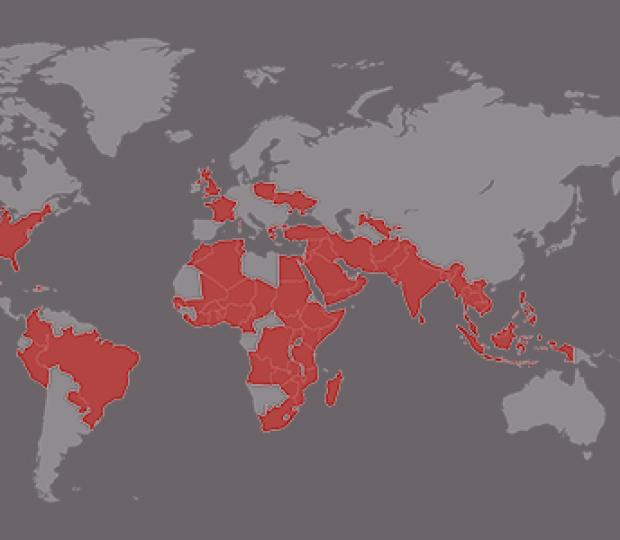
Disclaimer: This map is provided to facilitate the general location of the EAA supported projects. EAA does not have an official position regarding boundaries of or
disputed boundaries between countries.
Inclusive Education is an Engine for Peacebuilding
By Alisa Phillips, Senior Technical Advisor for Education, World Vision and Dr. Mary Joy Pigozzi, former Chief Education Officer, Education Above All Foundation
In today’s divided world, exclusion rarely begins with open conflict. More often, it begins quietly through poverty, stigma, harmful social norms, gender inequities, and the gradual, but critical, erosion of trust within communities and institutions.
When schools fail to include the most vulnerable children, the consequences extend far beyond learning loss. Exclusion weakens social cohesion, deepens inequality, and increases vulnerability to violence, exploitation, and instability. Conversely, when communities rally to keep children safe, in education, and connected to quality learning programs, education becomes more than a service delivery mechanism. It can strengthen inclusion, trust, and social cohesion within communities, helping create conditions that support more peaceful societies.
And perhaps most importantly, education programs contribute to social cohesion even when they are not explicitly labeled as “peacebuilding.”
Peace is more than the absence of conflict
Too often, peace is narrowly understood as the absence of violence. But sustainable peace is deeper.
Peace is restored trust.
Peace is inclusion.
Peace is a shared responsibility.
Peace is social cohesion.
Education systems both shape and are shaped by these conditions. Educational exclusion is not simply an education challenge. Its effects can extend beyond the individual child, weakening inclusion, opportunity, and social cohesion within communities.
Children who are out of school or not learning often live within ecosystems where trust has eroded, resilience to shocks is low, and communities struggle with fractured relationships and weakened collective responsibility for children’s well-being.
This is why the Humanitarian–Development–Peace Nexus matters to education. While humanitarian and development responses often focus on immediate needs and service delivery, strengthening the “peace” dimension of the nexus requires rebuilding the social fabric itself by strengthening trust, participation, inclusion, and community ownership.
In this sense, inclusive education can help strengthen the social cohesion and trust that underpin more peaceful and resilient communities. Exclusion often happens quietly — and so must peacebuilding.
Understanding inclusion and social cohesion in the Zambian context
Globally, more than 273 million children and youth are currently out of school, with millions more at risk of dropping out, particularly during the transition from primary to secondary school. Every child provided with quality education has the opportunity to develop greater agency, reducing their vulnerability to exploitation, abuse, early marriage, child labor, and communal insecurity.
This was one of the central lessons from our work in Zambia under the Empowering Vulnerable Children through Education (EVE) project, a partnership between the Education Above All Foundation (EAA) and World Vision with support from the Qatar Fund for Development: holistic education approaches can strengthen the ecosystem around the child while simultaneously building the foundations of positive peace.
In Zambia, many children face structural barriers that increase their vulnerability to educational exclusion which is why we focused on enabling education for the most marginalized. Vulnerable groups, including children with disabilities, children from child-headed households, and children engaged in child labor, face overlapping systemic and cultural barriers. Poverty, inadequate infrastructure, harmful social norms, and stigma often combine to push children further to the margins.
For girls in particular, risks include early marriage, pregnancy, and school-related gender-based violence. According to Together for Girls, 19% of girls who experienced physical violence by classmates and 9% of girls and boys who experienced physical violence by teachers reported missing school because of the violence. The 2024 Zambia Education Statistics Bulletin also highlights the continuing challenge of adolescent pregnancies. These barriers are often rooted in broader social, economic, and cultural factors that can weaken inclusion and social cohesion.
Ensuring access requires strong relationships
Traditional education programming often prioritizes access indicators: enrollment and attendance. While essential, access alone is insufficient. Keeping children in education and learning requires strengthening relationships across the entire education ecosystem: among teachers, parents, learners, schools, communities, and government systems.
Our focus included getting children into classrooms and building the trust-based infrastructure necessary to keep them there. Vulnerability is not created by a single factor, nor can it be solved by a single intervention. Children are more likely to remain in school when communities collectively value their education, support their participation, and help create environments where they can thrive.
Strengthening the ecosystem around the child
Several interconnected interventions helped strengthen social cohesion and build local capacities for peacebuilding.
Strengthening peer cohesion
Student clubs created informal learning and support networks where children could build trust with peers, strengthen confidence, and develop a sense of belonging. These spaces became particularly important for vulnerable learners who often experienced isolation or stigma.
Peer-to-peer cohesion matters because children frequently identify vulnerabilities among classmates before adults do. Student clubs helped normalize mutual support and strengthened protective social connections within schools.
Safe learning environments and gender-responsive pedagogy
Creating physically and emotionally safe learning environments was essential for retention, particularly for girls. Gender-responsive pedagogy helped teachers adopt more equitable and inclusive classroom practices while reducing school-related gender-based violence. Parents became more confident sending children, especially girls, to school when learning environments were perceived as safer and more supportive.
This work reinforced an important principle. Children cannot thrive academically where they do not feel safe emotionally.
Savings groups: Building trust through shared purpose
Savings groups, initially established as economic mechanisms, evolved into trusted community spaces where relationships and mutual accountability could grow. Communities bonded around common goals, strengthened social networks, and increased their collective capacity to support vulnerable children. Economic resilience and social cohesion often reinforce one another: when families feel more supported economically and socially, they are better able to prioritize education.
Child protection committees: Collective responsibility in action
Child protection committees strengthened local ownership around child well-being and reinforced the idea that protecting children is a shared community responsibility. Communities became active participants in identifying and responding to enrollment and retention vulnerabilities. This shift toward collective responsibility for education is itself a key peacebuilding outcome.
The role of Stay in School Committees
One of the most transformative components of the project was the Stay in School Committees (SISCs). These community-based structures became the cornerstone of efforts to identify and support children at risk of dropping out.
Using data from an adapted Early Warning System and Student Risk Matrix, SISCs monitored attendance, behavior, and academic performance to identify vulnerabilities early. Committee members conducted home visits, provided counseling, engaged caregivers, and mobilized community support before exclusion became permanent.
In addition to supporting children’s participation in education, SISCs strengthened the core elements of positive peace: trust, equity, information sharing, inclusion, and community relationships. Through their leadership and social capital, SISCs helped create a stronger sense of connection between schools and communities. Their commitment extended beyond project targets: they supported the re-enrollment of an additional 1,780 out-of-school children who were not originally included in the program. This demonstrated a shared belief that every child belongs in education and deserves the opportunity to learn. This is social cohesion in practice.
The Risk Matrix: Making vulnerability visible
The Student Risk Matrix became one of the most powerful tools. It functioned as an Early Warning System that identified children according to varying levels of risk based on attendance, behavior, academic performance, and social vulnerabilities. Crucially, it shifted the narrative away from blaming children for disengagement and toward mobilizing collective support around them.
By making vulnerabilities visible early, communities could respond proactively rather than reactively. Teachers, parents, and community structures gained a shared language and framework for intervention. The tool helped move children from hidden vulnerability toward visible support systems. Beyond supporting retention, the tool served as a practical mechanism for social cohesion by reinforcing connection, empathy, accountability, and shared responsibility for children’s education.
What changed through this holistic approach
The outcomes demonstrated that holistic, inclusive approaches can strengthen both educational retention and social cohesion simultaneously. Among the most significant results:
A 44% reduction in dropout rates
Improved inclusive teaching practices among educators
Greater community engagement in supporting children’s education and stronger ownership over educational outcomes
Stronger school-community relationships
Greater confidence reported among girls
Improved communication between parents and children, especially mothers and daughters — an increase from 59% to 78%.
These are more than child or family-level indicators. They reflect strengthened trust within the household ecosystem surrounding the child and a greater collective sense of responsibility for keeping children in school. These outcomes also extend to the wider community through stronger relationships, increased community engagement, and more robust support systems for children and their families. They are peacebuilding outcomes.
The sustainability challenge
Social cohesion requires continued investment and engagement. While the project demonstrated meaningful progress, significant challenges remain. Deeply rooted gender norms, economic vulnerability, resource limitations, and the need for ongoing teacher support continue to affect children’s educational trajectories. Sustaining social cohesion requires long-term commitment from communities, institutions and governments alike.
The encouraging sign from Zambia is that the Ministry of Education has recognized the value of the SISC model and is promoting it as a scalable and sustainable best practice. Its integration into national education structures increases the likelihood that support for vulnerable children will continue beyond the life of the project.
Enabling social cohesion through education
Several ingredients consistently emerged as critical:
Strong parental involvement
Improved parent-child communication
Greater community ownership
Safer school environments
Inclusive classroom practices
Early identification of vulnerabilities
Shared accountability for children’s well-being
Accurate and valued data
Together, these elements strengthened the critically important ecosystem around the child. Children remain in school when it is meaningful and when they are surrounded by relationships of trust, care, and support.
Final reflection: Education as quiet peacebuilding
In divided societies, peacebuilding is often imagined through large-scale reconciliation processes or formal conflict resolution initiatives. These have their place, but some of the most important peacebuilding happens quietly.
It happens when a teacher notices a child withdrawing from school.
It happens when a mother feels safe enough to engage with educators.
It happens when communities organize themselves to bring children back to school.
It happens when vulnerability triggers collective action instead of silence.
Our experience in Zambia demonstrated that holistic, data-driven education approaches can strengthen local capacities for peace precisely by rebuilding trust and shared responsibility around children.
When schools, families, communities, and institutions act together before children are pushed out, they are doing much more than improving retention and inclusion. They are helping to ensure that every child can realize their right to education, while strengthening the social cohesion and shared responsibility that contribute to lasting peace.
"Humanity will not overcome the immense challenges we face unless we ensure that children get the quality education that equips them to play their part in the modern world." -- HH Sheikha Moza bint Nasser












 September 28, 2026