








Breaking the Poverty Cycle: Empowering Youth as Innovators

By Noora Faisal Al Thani
Each year, the International Day for the Eradication of Poverty reminds us that poverty is not only a question of income. It is also about exclusion, inequality, and lack of opportunity. Nowhere is this more evident than in conflict-affected areas, where poverty is compounded by fragility, climate change, and displacement. To address poverty, we must move beyond short-term relief and invest in innovation that empowers youth as rights-holders and problem-solvers.
Innovation is not limited to technology. It is about rethinking participation, accountability, and empowerment so that resilience can be built where it is needed most. Seen through a human rights-based lens, economic empowerment becomes more than a program — it becomes an engine of justice, dignity, and opportunity for young people.
At the Education Above All Foundation (EAA), through our Silatech programme, we work with the belief that youth economic empowerment is not a side issue. It is a direct pathway to reducing poverty and building peace in fragile contexts. When young people are given agency, tools, and trust, they transform not only their own futures but also the prospects of entire communities.
Youth as Partners in Change
For too long, young people have been treated as passive recipients of aid and training. True innovation begins when youth are given a seat at the table — not as tokens, but as co-designers of the programs meant for them. When youth are part of steering committees, policy dialogues, and project governance, solutions are more relevant, more effective, and more sustainable.
Embedding youth voices into programs is critical because participation ensures ownership and long-term resilience. When young people help shape solutions, they hold themselves and institutions accountable for results.
Reaching Those Left Behind
The promise of poverty reduction must begin with those furthest excluded — young women, displaced youth, and rural communities. In Sudan, Razaz Talib Abaker, a graduate without employment prospects, transformed her future by organising 30 women into a cooperative called Thiga (“Trust”). Through a partnership between EAA Foundation and UNDP , they gained access to improved seeds, training, and a grain mill — the first in their village. This not only enabled Razaz to secure employment but also generated new jobs and strengthened food security.
What began as one woman’s struggle became a collective force for livelihoods and community development. Today, Thiga strengthens food security and resilience among women in fragile rural economies. Razaz’s journey proves that when marginalised youth are empowered, entire communities are uplifted — but when they are left behind, the fight against poverty is nothing more than rhetoric. For policymakers, the lesson is clear: real poverty reduction must start with those left furthest behind.
From Tokenism to Agency
Moving from symbolic inclusion to real empowerment means equipping youth with agency, future-proof skills, and access to markets. This includes transferable skills that can withstand fragile economies, as well as feature-ready skills like digital and AI literacy. Without closing the AI divide, inequality will only deepen, especially in conflict-affected contexts.
One example is Ahmed Assad from Egypt, whose graduation research project evolved into Bioteel, a youth-led initiative producing bio-based fertilizers and pesticides as sustainable alternatives to harmful chemicals. With support from EAA Foundation and UNICEF’s Generation Unlimited, Ahmed transformed his academic idea into a venture that enhances soil health, mitigates environmental damage, and promotes safer food production. Beyond the environmental benefits, Bioteel has created pathways for youth employment in research, production, and distribution. Ahmed’s journey proves that when young people are trusted with resources and space, they design solutions that tackle food insecurity, environmental degradation, and unemployment simultaneously — and multiply benefits for their communities.
Beyond Promises
Innovation demands accountability. It is not enough for programs to set ambitious targets — they must also create mechanisms for youth to influence and monitor outcomes. In Sudan, EAA Foundation’s Silatech programme and FAO’s work through Farmer Field Schools does just that.
These schools offer agricultural training as well as platforms for knowledge exchange, community oversight, and feedback. They ensure that youth are not only beneficiaries but also active contributors to the systems that shape their livelihoods. Accountability makes the difference between temporary relief and long-term transformation.
Employment as Peace and Resilience
In conflict-affected areas, jobs are not only about income. They are strategies for peace, stability, and resilience. EAA Foundation’s employment projects in Sudan, implemented with FAO and UNDP supported by QFFD, exemplify this. By creating jobs in agriculture and livestock for displaced youth, these projects not only safeguard food security but also reduce the risks of conflict, exclusion, and forced migration. When livelihoods are restored, communities regain stability and the prospects for peace strengthen. This is why youth economic empowerment is not just a development policy — it is also a cornerstone of peace and stability in fragile regions.
Financing Youth Innovation
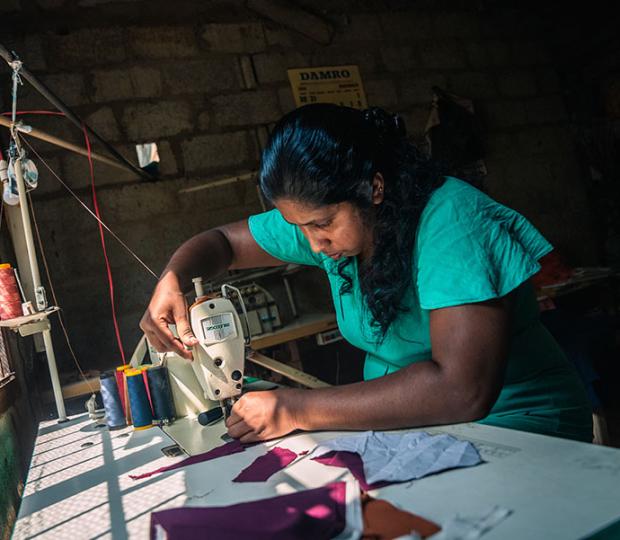
No innovation can thrive if youth remain excluded from innovative finance. Microfinance, blended finance, and youth-focused investment models are crucial in removing barriers. In Sri Lanka, Anjani Basnayaka, a 25-year-old artisan, expanded her weaving business with digital microloans under the EAA Foundation partnership with Gojo Inc.
From producing four items a month, she now sells 40, employs others, and saves for her future. Financial inclusion transformed a passion into an income-generating livelihood, demonstrating how accessible financing empowers young women to build independence and create opportunities.
Partnerships for Scale
Poverty eradication is too complex for any single actor. Governments, international organisations, the private sector, and local communities must work together. At EAA Foundation, we focus on cross-sector partnerships that integrate employment, education, and climate action. Innovation here means aligning diverse resources and mandates toward a common goal: youth economic empowerment as the pathway out of poverty. Partnerships are the multiplier that turns development projects into systemic change.
A Call to Action
On this International Day for the Eradication of Poverty, we must recognise that innovation is not about the latest technology. It is about redesigning systems to empower young people with agency, resilience, and opportunities.
The real question is not whether young people are ready to lead — they already are. From Sudan to Egypt and Sri Lanka, they are proving it every day. The question is whether governments, international organisations, and investors will commit to supporting them at the scale required.
Eradicating poverty begins with this recognition — and with the resolve to act decisively through financing, innovative partnerships, and systemic reform.
Disclaimer: The author first published this story in October 2025 on Yeni Safak website. Click here to read the original post.